
World's Most Rugged Cell Phone
Class I, Division 1
Tuesday, April 10, 2012
The Future Looks Brighter with Intrinsically Safe Lighting Solutions
If your work environment has you in hazard area locations day in and day out, one tool that is essential is a reliable Class I, Division 1 flashlight or headlamp for your hard hat. Make sure your device is providing you the best lighting possible with an LED bulb, 32 hours of sustained operation and a 500' range on the optics. Technology for 3 of the best performers on the market are now offered in the smallest and most efficient form factor in it's class. No more two handed operation to turn the light on and off, with a single tail switch and ergonomic design these are the best solutions available today. Because they all use new Compound Path Optics (CPO) you have the brightest LED lights for the toughest jobs you do. Go ahead, Brighten Your Future with an intrinsically safe flashlight.


Thursday, March 8, 2012
Defining Misperceptions on Intrinsically Safe and Nonincendive Equipment
Voodoo Science
Nonincendive Circuits are better than Intrinsically Safe Circuits (NOT TRUE)
This misconception is
mainly because nonincendive circuits employ the same basic rationale for
reducing the risk of ignition of a hazardous atmosphere both rely on energy
limitation. Also the sound of the word
itself nonincendive is part of the voodoo.
The word nonincendive strongly sounds to a layman like something simple
that will not (Lite, Ignite or set A Fire) any atmosphere. On the other hand
the word Intrinsic itself which sounds foreign, mysterious, microscopically
looked at in detail. The word Intrinsic
sounds complicated must be thoroughly looked at in detail if not it will (Lite
Ignite or set A Fire) any atmosphere at the smallest quantity. This is reversed rationale and logic
otherwise we can call it voodoo science.
The important
differences nonincendive circuits are permitted in Division 2 and Zone 2
classified locations only. Intrinsically safe circuits on the other hand, are
suitable for use in Division 1 and 2, and Zone 0, 1 and 2 classified locations.
The main difference between the two types of equipment is that nonincendive
circuits are evaluated for ignition capability under normal operating
conditions, while intrinsically safe circuits are evaluated under fault
conditions. During an evaluation of an intrinsically safe circuit, it is allowed
to introduce up to two independent faults per the requirements in the
applicable product standard in an attempt to increase the energy available in
the circuit. Under these conditions, the circuit must still be incapable of
causing ignition of the specified gas either by introduction of a spark
(shorting of two points in the circuit) or by thermal effects of individual
components within the circuit.
Therefore Intrinsically Safe Circuits are better
than Nonincendive circuits (THIS IS TRUE)
Intrinsic safety and nonincendive equipment and
wiring methods are practices where apparatus is designed with low power levels
and low stored energy, so that an arc produced during normal functioning of the
equipment or as the result of equipment failure has insufficient energy to
initiate ignition of the explosive mixture. Equipment enclosures can be
pressurized with clean air or inert gas and designed with various controls to
remove power or provide notification in case of supply or pressure loss of such
gases. Arc-producing elements of the equipment can also be isolated from the
surrounding atmosphere by encapsulation, immersion in oil, sand, etc. Heat
producing elements such as motor winding, electrical heaters, including heat
tracing and lighting fixtures are often designed to limit their maximum temperature
below the auto-ignition temperature of the material involved. Both external and
internal temperatures are taken into consideration.
Section 500.7(F) of
the National Electrical Code explains that it is a protection technique for
equipment installed in Class I, Division 2, hazardous (classified) locations.
With the advent of more stringent environmental regulations, intentional
release of flammable materials is greatly restricted and, with the resulting
changes in containment techniques, many areas that previously were classified
as Division 1 (continuously flammable) have been reclassified as Division 2
(infrequently within the flammable range).
This allows the
installation of nonincendive equipment in applications previously limited to
Division 1 protection techniques, such as explosion proof or intrinsic safety.
Nonincendive equipment tends to be less costly and less complicated to maintain
than Division 1 equipment. The obvious economic benefits will mean that this
protection technique will see an expanded usage in the years to come.
The same concept can
be applied in Class II and Class III, Division 2, locations; but, in those
locations, the enclosures of the nonincendive equipment must also prevent the
entrance of dust.
In an
industrial plant such as a refinery or chemical
process plant, handling of
large quantities of flammable liquids and gases creates a risk of leaks. In
some cases the gas, ignitable vapor or dust is present all the time or for long
periods. Other areas would have a dangerous concentration of flammable
substances only during process upsets, equipment deterioration between
maintenance periods, or during an incident. Refineries and chemical plants are
then divided into areas of risk of release of gas, vapor or dust known as
divisions or zones. The process of determining the type and size of these
hazardous areas is called area classification. Guidance on assessing the extent
of the hazard is given in the NFPA 497 Standard, or API 500 and according to their
adaptation by other areas gas zones is given in the current edition of IEC
60079.10. For hazardous dusts, the guiding standard is IEC 61421.10.
Typical gas
hazards are from hydrocarbon compounds.
Safe area
An area such as a residence or office would be classed as
safe area, where the only risk of a release of explosive or flammable gas would
be such things as the propellant in an aerosol
spray. The only
explosive or flammable liquid would be paint and brush cleaner. These are
classed as very low risk of causing an explosion and are more of a fire risk
(although gas explosions in residential buildings do occur). Safe area on
chemical and other plant are present where the hazardous gas is diluted to a
concentration below 25% of its lower flammability limit (or lower
explosive limit (LEL)).
Division 2 or
Zone 2 area
This is a step up from the safe area. In this zone the
gas, vapor or mist would only be present under abnormal conditions (most often
leaks under abnormal conditions). As a general guide, unwanted substances
should only be present under 10 hours/year or 0–0.1% of the time.
Division 1 or Zone 1 area
Gas, vapor or mist will be present or expected to be
present for long periods of time under normal running. As a guide this can be
defined as 10–1000 hours/year or 0.1–10% of the time.
Zone 0 area
Gas or vapor is present all of the time. An example of
this would be the vapor space above the liquid in the top of a tank or drum.
The ANSI/NEC classification method considers this environment a Division 1
area. As a guide this can be defined as over 1000 hours/year or >10% of the
time.
In the case of dusts there is still a chance of explosion. An old system of
area classification to a British standard used a system of letters to designate
the zones. This has been replaced by a European numerical system, as set out in
directive 1999/92/EU implemented in the UK as the Dangerous Substances and
Explosives Atmospheres Regulations 2002
The boundaries
and extent of these three dimensional zones should be decided by a competent
person. There must be a site plan drawn up of the factory with the zones marked
on.
The zone
definitions are:
Zone 20
A place in which an explosive atmosphere in the form of a
cloud of combustible dust in air is present continuously, or for long periods
or frequently.
Zone 21
A place in which an explosive atmosphere in the form of a
cloud of combustible dust in air is likely to occur, occasionally, in normal
operation.
Zone 22
A place in which an explosive atmosphere in the form of a
cloud of combustible dust in air is not likely to occur in normal operation
but, if it does occur, will persist for a short period only.
Monday, February 13, 2012
The Value of 'Fully Rugged vs. Non-Rugged'
As with all major Fortune 500 companies that have large field workforces, the on-going debate is always having a fully rugged solution deployed over a non-rugged device. Organizations that have mission critical applications understand the true total cost of ownership along with the reliability and
up-time of these devices. There is only one mobile computing solution with a 'bumber to bumper' 5 year warranty. This fully rugged device vs a commercial grade pc with only a 12 month warrranty along with the philosophy of buy 'em cheap and stack 'em deep is extremely flawed. Especially from an IT support and maintenance level not to mention having field personnel that routinely experience down-time with commercial grade laptops. Talk about making it very hard for companies to justify operational efficiency without the correct mobile devices deployed or even provided. Now add the fact that you're world operates in an explosion hazard area where a certified device is mandatory. ATEX, NEC and IECEx devices are far and few between, be sure your vendor/supplier has all the world certifications. Thus allowing an employee to operate globally, whether he's offshore in Louisiana one day or Nigeria the next.

up-time of these devices. There is only one mobile computing solution with a 'bumber to bumper' 5 year warranty. This fully rugged device vs a commercial grade pc with only a 12 month warrranty along with the philosophy of buy 'em cheap and stack 'em deep is extremely flawed. Especially from an IT support and maintenance level not to mention having field personnel that routinely experience down-time with commercial grade laptops. Talk about making it very hard for companies to justify operational efficiency without the correct mobile devices deployed or even provided. Now add the fact that you're world operates in an explosion hazard area where a certified device is mandatory. ATEX, NEC and IECEx devices are far and few between, be sure your vendor/supplier has all the world certifications. Thus allowing an employee to operate globally, whether he's offshore in Louisiana one day or Nigeria the next.

Tuesday, January 31, 2012
Noise Induced Hearing Loss #1 Occupational Illiness
The other day while gaining access to a plant in Texas I was offered the standard safety orientation. Normally, I carry my own hard-hat and safety goggles but rarely think about hearing protection.
A great business colleague, Pam Cheesman, Sensear - Southwest Account Executive provided the following; "Noise Induced Hearing Loss is the number one occupational illness in the world. Communication in high noise is also a big issue, especially in the Oil & Gas industry, due to the high noise throughout the plants. As a result, workers remove their hearing protection to try and hear communication or they have to constantly step away from the noisy area to be able to hear their 2-way radio or cell phone call. The Intrinsically Safe certified headsets (ATEX, IECEx, Class 1/Div 1) are allowing Sensear to provide solutions for this issue globally. In two recent surveys, the results showed that at least 40% of workers lose over 30 minutes a day trying to communicate in high-noise environments."

A great business colleague, Pam Cheesman, Sensear - Southwest Account Executive provided the following; "Noise Induced Hearing Loss is the number one occupational illness in the world. Communication in high noise is also a big issue, especially in the Oil & Gas industry, due to the high noise throughout the plants. As a result, workers remove their hearing protection to try and hear communication or they have to constantly step away from the noisy area to be able to hear their 2-way radio or cell phone call. The Intrinsically Safe certified headsets (ATEX, IECEx, Class 1/Div 1) are allowing Sensear to provide solutions for this issue globally. In two recent surveys, the results showed that at least 40% of workers lose over 30 minutes a day trying to communicate in high-noise environments."
She further stated, "Our clients that have adopted
Sensear into their environment, have seen a huge difference. Workers that used
to scream at each other, use hand signals or just not communicate at all until
they were in a quieter area, are now communicating much more efficiently,
without any delay and in a much safer environment because of the situational
awareness that the Sensear headset provides."
When you consider your work environment, especially when exposed to any type of industry manufacturing where high noise is constant, hearing protection should be first and foremost.
Tuesday, January 24, 2012
Cell Phone Results in Fire and Personal Injury
Recently, a
flash fire occurred on a platform in the Gulf of Mexico OCS Region while a
contract panel specialist was working on an open panel that used supply gas for
the instrumentation. The contractor was carrying an uncertified cellular phone that was
turned on and rang while working on the panel. When the employee flipped the
bottom piece of the phone to answer the call, a flash fire occurred causing
second degree burns on his forearms and face.
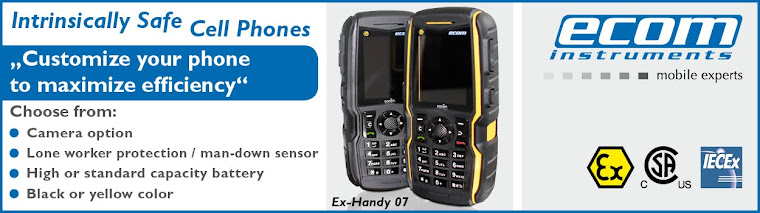
If your company personnel conduct routine work in explosion hazard areas you have to consider the safety and compliance of those employees within Refineries, Petrochemical, Oil & Gas both Upstream and Downstream, Pipelines, Mining & Pharmaceutical locations. Now that a Class I, Division 1 cell phone is offered on a GSM network along with Global certifications including; ATEX, NEC, IECEx these types of accidents to loss of life and assets don't have to occur.
If your company personnel conduct routine work in explosion hazard areas you have to consider the safety and compliance of those employees within Refineries, Petrochemical, Oil & Gas both Upstream and Downstream, Pipelines, Mining & Pharmaceutical locations. Now that a Class I, Division 1 cell phone is offered on a GSM network along with Global certifications including; ATEX, NEC, IECEx these types of accidents to loss of life and assets don't have to occur.
Subscribe to:
Comments (Atom)